Showing posts with label street art. Show all posts

The Crystal Ship 2019: The Dictatorship of Art


The fourth edition of The Crystal Ship street art exhibition is built around The Dictatorship of Art, in a collaboration with Theater aan zee. 

If art was a dictator, he would tell you to be free. Basically art has the democratic ability to alter the world.

In 2019 the acclaimed street artists created ten murals, two sculptures, some interventions by Helen Bur who put portraits on inhabitants' walls, three school projects and Portuguese artist in residence Wasted Rita who used the city as her playground.

The tour takes off at the Tourism Office in Ostend, where free cycling and walking maps are at your disposition.

A Crystal Ship Kids Guide is available to make it more fun for the youngsters.

Once again the participating artists came from over the world: from the popular Belgian Jaune, over French Miss Van, German Case Maclaim, American Crystal Wagner to British David Walker, Spanish Escif, Marina Capdevila, Mohamed l’Ghacham and Dutch Leon Keer.


Wasted Rita Ostend street art interventions

https://www.visitoostende.be/sites/default/files/the_crystal_ship_2019_print.pdf

Second edition of The crystal Ship

The Crystal Ship 2017: Jaune

The second edition of street art festival The Crystal Ship was officially opened on April 8th. 


One can start the free walking or bicycle tour at the Achturenplein in Ostend. Free maps will guide you towards original public artworks that alter your view on creativity and urban environment.

The participating artists came from over the world to share their installations and murals. Belgians Strook, Hell'O Collective and Jaune, French Outings Projects, C215,  Nelio and Levalet, Argentineans Bosoletti, Hyuro and Pastel, British Phlegm, Spanish Sebas Velasco and SpY, Portuguese Alexis Diaz, American Axel Void,  German Johannes Mundinger , Norwegian Henrik Uldalen left their marks for us to discover.

Vhils destructs to construct

Vhils copyright


Portugese artist Alexandre Farto(1987) grew up in an industrialised suburb, affected by the 1974 Carnation revolution. The destruction of the war influenced his work and way of thinking.
Vhils has been active in urban interventions since 2000. First trains around Europe were bombed, then stencils and pastes appeared.
In 2008 his carving pieces of the Scratching the Surface series were shown at the Cans Festival in London, on invitation by Banksy.  
The artist uses an innovative cutting technique to remove multiple layers of a wall or billboard posters to form a poetic artwork. The action of the method is the message: destruction and decay are used to create unpredictable artwork as he never knows what the underlying images will turn out to be. The history of urban space, revealed by the destruction of walls with explosives and drills , shows the textural contrast with contemporary public space.
Projected or painted photographs of unknown individuals are used as humanizing icons to criticize advertising ideals and the distressing urban environment. The carved layers symbolize the socio cultural influences and our individual struggle in society.
Vhils' work has been shown at the Sao Paulo Biennial, the Lazarides Gallery in London and Magda Danysz Gallery in Paris. He expresses himself with a variety of media: from stencil painting to wall carving, from collage to screen printing, from works on metal( the erode, apathy and ferrugem series), cork, styrofoam or wooden doors to video installations.
Still Vhils' fascination with dissection remains primordial.

Collective narcistique


In 2009 Niemand( Yivic Fiers, 1981) and Russian Sergej Andreev hung canvasses in the streets for others to take home. Their Kunst Op Straat( art in the street) project evolved towards Collective égoïste, which combined individual canvasses and stencils. Their name refers to their clashing ego's on exhibitions in squatting buildings.

Sergej Andreev is known for using icons to criticize consumerism and politics. He depicts religious images with Gucci glasses and superheroes. His sculptures are composed of relics and self made robots.

As a sixteen year old Yvic Fiers( then using artist name Scum) had his first spray paint experiences with his friend Freddy D. Niemand stands for a fat victim of consumerism.

Since 2012 Niemand and Andreev collaborate in Collective Narcistique, an anarchist, left wing group which focuses on socio-political criticism on topical subjects. Henk De Ruddere and Michel Clair often take part in their street interventions.

Carrots and tape were the main ingredients of their carrot bombs , installed at the door of the Museum of Contemporary Art in Ghent and the surrounding park. In the red light district they shared their Love, take as much as you need leaflet.

In 2014 the duo, dressed in white uniforms with nigger written on their backs to denounce a racist tag, installed a large scale version of Malhaize(sickness) at the docks in Ghent. The political piece shows the Belgian right wing political NVA party in combination with the adapted Delhaize logo.

Recurring laser stencils include the sheep Sheepo, skulls, mayor Daniel Termont, the humoristic What would Mac Gyver do? and House(Everybody lies).

Anarchism meets a bunch of friends.


Icy & Sot

Icy and Sot Coke can Tabriz, Iran
With funny artist names referring to icy and drunk and a challenging piece called Beer Is Not a Crime, Iranese siblings Icy(1985) & Sot(1991) are on their way of becoming as good as their role models Blek Le Rat, Banksy, Dolk, Blu and King Stencil.

The young men, who were very fortunate to have progressive parents, grew up in the city of Tabriz. In 2005, the passionate skaters started stenciling skate logos, skulls and computer game images on their boards. Their first amateur stencils were merely made of cardboard and X-Acto knives. They tackled skate parks and the streets, where their stencil and sticker work would be covered up in a jiffy. The brothers also created a giant Coke can sculpture out of a corroded tank situated near Tabriz.

They soon got in trouble because they were using green paint, which the police linked to green protest groups. The young men were caught several times in their homeland, having been interrogated for days at a time. After fulfilling their military service, they were allowed to leave the country. 
Their critical Thief piece, depicting Iranese president Ahmadinejad and Syrian Assad made it impossible to return to their country where street art is highly dangerous and illegal, could even lead to a Satanism charge.

Their universal works about war, peace, hope, love, hate, despair and human rights have been stenciled in the streets of Iran, Turkey, Paris, Sao Paulo, Los Angeles, Houston, Chicago, San Francisco and New York. Dutch street art collectors Klerlx and van Gelderen discovered the stenciling brothers. The boys' creations are represented by their Art Agency. From 2009 on, the duo had gallery shows all over the world, from Teheran, Rome, Paris, Los Angeles, Adelaide to New York.

In 2012, their pieces were shown at Pori Art Museum's Street Art – The New Generation exhibition in Finland. The same year, their Made in Iran show at the Open House Gallery in Manhattan was an incredible success. 

In March 2013, the brothers went on a Four City East Middle West tour, with shows and musical performances by the Yellow Dogs in San Francisco, Los Angeles, Houston and Chicago. 

After winning the Red Bull Curates: The Canvas Cooler Project, they exhibited work at the Art Basel Miami Beach SCOPE fair(2013). 
They applied their signature stencil of the walking boy, which they have used all around the world. The boy represents all of those innocent Iranian children, who live in crazy surroundings while trying to keep that childlike sense of exploration and innocence. 

Children are often depicted in their creations because their happiness seeking, playful and explorative attitude is easy to relate to. 

Now living in Brooklyn, where spray paint is a lot easier to find, 
Icy & Sot continue their unique social crusade, making plans to go on a European tour.

Icy and Sot Beer is not a crime

WK Interact

copyright WK Interact

French WK Interact(1969) is well known for his black and white pieces of the human body in motion.

In the nineties he fell in love with New York while touring the United States. A few years later he decided to leave his beloved Caen. He moved to his beloved apple with a project in mind. This is when his full size images started appearing on New York buildings. A lot of this work was situated in wisely chosen Manhattan and Brooklyn areas.  

Inspired by the city's energetic chaos, WK succeeds in adding a dynamic rush in his mobile characters. The street artist uses a variety of media such as installations, paintings, collages, prints and photocopies.  His photocopied photography is often the starting point for the creation of a piece. 

With shows at Agnès B galleries and the Jonathan Levine gallery(2013, 2010, 2009, 2008) Interact may say his work paid off.

www.wkinteract.com

Bonom, le singe boiteux


Vincent Glowinski(1986) first enlarged his sketches in urban settings such as abandoned houses or factories. He was clearly bitten by the overwhelming sense of freedom and adventure outdoor creation brings on. Tagging freed his nostalgic teenager mind.

When the Parisian artist came to Brussels to study arts, he felt inspired by animals in the museum of science where he had to study their anatomy during school trips. Bonom, a contraction of homme and bonobo, was born.

Bonom's black painted animals and skeletons appeared in Paris and Brussels in 2005. Mysteriously painted on hard to get to rooftop spots, far away from the hectic life downstairs. These dangerous spots allowed more overview and hiding places, although they were very close to sleeping individuals in their flats.

In 2007 the artist was asked to draw dinosaur skeletons on the museum of natural sciences in Brussels. 

Later on he painted human figures, fetuses, a portrait of his father with the body of a snake and the masturbating woman.

After meeting Wim Vandekeybus in 2010, collaborations on murals and dance performances followed.

Glad to be freed from a street artist's restraints Glowinski now only works on commission under his real name.

The release of an art book(CFC Éditions ) accompanies Bonom's first solo exhibition "Bonom, le singe boiteux" in art institute L'Iselp's gallery. The artist's drawings, sketches and an enormous sculpture are illustrated with photos by Ian Dykmans(1974), who started following Bonom in 2007. 


'Bonom, le singe boiteux'
24th of January-  22nd of March
L'Iselp, Waterloolaan 31B , 1000 Brussels. 
Monday- Friday: 11- 18.
Free admission.

SpY doesn’t lower your cholesterol


SpY Banana, New York, 2008, copyright SpY

SpY is an anti-conformist street artist from Madrid whose first graffiti attempts took place in the mid 1980′s.

He soon abandoned graffiti to explore the vast variety of other artistic media. He first spread his name by means of posters, then by altering billboard advertisements.

His street art work is based on the observation of urban components which he replicates or transforms to produce innovative urban art installations that comment on urban life. Readapted everyday objects create a dialogue, ironic interventions encourage reflection.

Whether traffic lights, road signs, phone booths, police cars basketball courts or Braille messages, SpY wants his humorous interventions to cause an interpolation in the apathetic urban setting, to surprise people with something unexpected, to awake their ordinary lives and make them smile. 

The essence of street art


The street art movement arose from the graffiti movement, which was a reaction to the injustice poor youth in NY were confronted with.

Imprisoned in their social situations, artists used graffiti as an artistic 
protest against the authorities. The expression form, mostly applied in subway stations and public buildings, provided urban frustrations 
with a sound board, a highly original way to share personal opinions and inspiring, positive messages about politics and social abuse in a dysfunctional society.

Street art is a revolutionary art form based upon the continual relation with passers-by and the environment. The concept surpasses the narrower meaning of graffiti but it did remain loyal to the playground and the direct interaction with the public.

By means of a self devised , utmost unique language versatile artists communicate activist, critical messages about political and societal themes, materialism, consumerism, violence, immorality or propaganda for a good cause: to influence the collective behavior and stimulate reflection.

The use of catchy, popular images easily attracts passers-by, who connect with the recognizable, to mass culture referring symbols such as comic characters, super heroes or celebrities.

The spray cans made room for an immense variety of expressive forms: from collages, murals, installations, sculptures, video projections, stencils, knitta, photography, poster and sticker art, to virtual kidnappings.

Evolved from a territorial subculture into an innovative, surprising, subversive phenomenon, providing each and every one worldwide with free art, street art performs the essential role art should have in the development of insights and perceptions.

With its diverse references, interactive messages and intrinsic motivation the possibilities remain endless.

Banksy Better Out Than In


October was a busy month for Banksy who was touring the streets of New York while mass producing. Each day another outdoor piece was shared on the artist's website.

His Better Out Than In project is illustrated by a quote of Cézanne: "All pictures painted inside, in the studio, will never be as good as those done outside."

The artist used different media such as installations, stencils, videos, sculptures and performances.

He converted a delivery truck into a mobile garden with butterflies, a waterfall and a rainbow. One of the traveling  installations was entitled Sirens of the Lambs and featured a traveling slaughterhouse delivery truck filled with stuffed animals. A real boy was shining the shoes of a fiberglass Ronald McDonald in the South Bronx, a sculpture of a Sphinx was placed in Queens and a video of ants evolving into a vulva was shown in Staten Island. 

Banksy set up a stall to sell original artworks for sixty dollars each and put a jpeg on his website which can be used to make one's own Banksy New York residency souvenir T shirt.

He said goodbye to New York with a balloon throw-up on the Long Island Expressway and asked the public to save 5pointz, an outdoor urban art exhibit space in Long Island City.

Truly: at first the project seemed to be a massive media stunt but one might agree that the concept, the creativity and the used techniques show the artistic abilities of this street artist who criticizes consumerism.  

Banksy in Gent next?! 


The New York Times opted not to publish
 this letter from 
Banksy, stating that
the WTC building is an eyesore. 

The feminine side of Nuria Mora


Nuria's very feminine, poetic work is best witnessed in the street environment it is correlating with. 

The Madrid inhabitant, who studied interior design and fine arts, uses brushes and latex paint to create her individual reflections on new ways of seeing our urban environment.

She wants to form a quiet, neutral spot where passers-by can stand still to form their thoughts.

Her Take Over Madrid billboards are composed of natural elements, butterflies and boldly colored geometrical designs. Other recurring elements include lines, patterns, plants and flowers. 

The artist often collaborates with Eltono; both are members of the street art collective Equipo Plastico(with Nano4814 and Sixe). Together they have made street sound installations and light graffiti.

Nuria's gallery work differs from the work she places in the landscape. Her internal world is translated in the form of installations, videos, murals, drawings and watercolor.

Her work has been shown in galleries and museums such as Tate Modern and the Miró foundation.

Beejoir does what he likes best

Beejoir, LV child
Beejoir, a British street artist whose pseudonym derives from a nickname, has been living in Thailand for over a decennium, where anti graffiti laws are non existent. This is where he founded the Souled Out Studios print house in 2004.

Although he was thrown out of art class at the age of 14, Beejoir felt the need to express his thoughts and indeed street art was the easiest way to do so. Recurring meaningful themes include politics, world affairs, religion and consumerism. A versatile artist who strongly dislikes the hidden-meaning concept.

His oeuvre includes paintings, prints, sculptures, photos, wheat pastes and stencils. His pieces are marked by rich contrasting colors and juxtaposed imagery. 

There's nothing greater than doing what you love every day of your life.

Ron English billboards modern culture criticism

Copyright Lazarides Gallery 
American artist Ron English studied photography but chose to concentrate on becoming an exquisite painter and an inspiring street artist.

From 1982 to 1984 he was part of an art crew who modified billboards to communicate criticism on politics and consumerism with passers-by. An essential characteristic of his oeuvre remains this culture jamming: the liberation of an advertisement's commercial message by adding his own, often by means of the use of colorful pop culture's iconography. No need to say English feels inspired by Andy Warhol. His subversive POPaganda conveys sociopolitical satirical reflections on modern culture.

Hand painted popular imagery as comic superheroes, Disney characters, animals, cowgirls and skeletons are used to open a humorous dialogue with the public, often leading to media discussions. The pop iconoclast's Abraham Obama pieces during the 2008 presidential campaign had a strong impact on the election.

Like Dan Witz, English is also a master in photorealistic painting. His versions of symbolical artworks as Picasso's Guernica or Degas' the Absinthe Drinkers illustrate his craftsmanship. Street pirate Ron English simply deserves the name he has on the street.


El Mac's premium picture perfect

Mac and Retna Miami
Autodidact Miles Mac MacGregor(1980) has been studying art as if it were a religion. When growing up, the art that spoke to him was the art which looked real.

El Mac started painting with acrylics in the mid ’90s, realistically rendering human faces and figures.  After being blown away by the Subway Art book he started experimenting with graffiti(1994). A perfectionist at heart, he always desired to create perfect, super tight works of art. Having to paint quickly in the dark was a fruitful lesson for this portraitist. 

Painting from photographs and from life, El Mac has been described as a photorealistic painter. His detailed representations of a large variety of individuals look perfect, meticulously lifelike, moving your inner sensations in each and every way.

This technical master who uses iced spray cans to create an energetic rippled effect, desires to affect people in the same way he's inspired by paintings, to connect with the public and to change how others think.

His aesthetic preferences have evolved over the years, growing more appreciation for abstraction.

El Mac often collaborates with Retna, who's in charge of the typography while Mac paints the figures. Interacting with another artist balances Mac's introverted and extroverted sides. The duo painted an enormous mural for Primary Flight Art Basel Miami Beach(2007- 2009), held an exhibition at the Robert Berman Gallery(2009) and released a book entitled Alianza: Mac & Retna which documents their individual and collaborative works in three sections.

Mac's classical influences were illustrated by his interpretation of the Flemish Primitives at the Groeningen Museum in Bruges(2003).
With solo shows in San Francisco (2009, Fifty24SF Gallery), New York(2010, Joshua Liner Gallery) and sponsored murals for the Pasadena Museum(2011), the MARCO(2010) and the Cisneros-Fontanals Art Foundation(2012, Havana Biennial), more canvases and public work are to be looked forward to.

There’s always more to learn, more to discover, and MacGregor will definitely do it in his own unique way.

http://elmac.net

Publication:
Alianza: Mac & Retna, 2009, Upper Playground/Gingko Press, 
ISBN: 978-1-58423-359-6 

Blek Le Rat filling our modern world's emptiness


Copyright Blek Le Rat 


This revered street artist is best known for his iconic black rat (anagram of art) silhouettes, symbols of the urban environment and of the fear those invasive marginalized animals provoke. 


Blek's style is often compared to Banksy's. Only difference is that Le Rat was stenciling walls while Banksy was still a kid.


While others were doing political graffiti in the 80's, Blek Le Rat started stenciling his rat silhouette on Parisian walls, hoping to provoke others to express themselves in the same way. The preparation( drawing and cutting) of these stencils took him over a week. Around 1981 he stenciled small black rats, bananas, running red men, little faces and a self-portrait. 


Graffiti wasn't criminalized yet, allowing him to create a multitude of rats and tanks all around Centre Pompidou and frankly answering inquisitive policemen he was doing art.


After a couple of years the small pieces developed into life size figures.
Inspired by a photograph of an old man from Belfast, he created the Old Irish Man in 1983. This piece, symbolizing civic courage, was reproduced all over France. Other full size images followed. (among others Andy Warhol, a Woman from Bangladesh, Mitterrand, Joseph Beuys, Jesus Christ, Two dogs mating, ...)


His first and last collaboration took place in 1984, when he and Bergu from Surface Active worked together on a stencil fresco on the Louvre's fences.


Le pochoir became a popular way of expression, as referred to in Le Monde(1986) as L'école de Blek le Rat. His pioneering technique added a new perception upon art and design. His work inspired other stencil artists such as Logan Hicks and Swoon.


After some graffiti charges in 1991, he chose a safer method: posters and cut-outs. Working on paper changed his approach towards working in urban space, allowing him to work in other areas freed from the constant fear of being caught.( e.g. self portrait, French Soldier)


He tackled some ancient mythological subjects(Centaur, Faun) and experimented with Michelangelo's (faun, David) and Caravaggio's imagery( Madonna and Tribute to Caravaggio).
His wish to influence social change became apparent in 2003 when he created his American Soldier(2003) to criticize the Iraq war. He pasted hundreds of posters of the kidnapped French journalist Florence Aubenas(2005) throughout Paris and pasted tragic fairy tale symbol Lady Diana(2006) on the walls of Tate Modern.


Aware of the architectural impact of image, time and space, his images are always linked to the social urban environment. It explains why his Greek lady was found in multicultural areas. 


His street art raises global social awareness on issues as discrimination, the solitude of the elderly, the homeless, poverty (Woman from Bangladesh), loneliness, people living on the fringes of urban society( Beggars). His pieces have permeated public consciousness and have had a profound effect on people's critical thinking.


Le Rat's art is all about purity of content and imaginative thought-provoking imagery. 


Real life passionate rebellion against art imprisoning institutions, now who could object to that? 


Watch:
Blek le Rat- Original Stencil Pioneer 2006
Bomb It 2007


Article written by Ann Timmermans

Mark Jenkins always in the humour

Embed series Mark Jenkins


American mixed media sculptor Mark Jenkins' fascination for sculpture sprung up after seeing the 2001 Juan Muñoz exhibition at the Hirshhorn Museum in Washington DC.

Since then Jenkins has been installing witty street art installations in urban and environmental settings.

His first street art piece was a giant sperm made out of tape at Copacabana beach in 2003. He soon began focussing on figurative self-cast sculptures.

His Embed series composed of dressed human figures installed in urban settings excite passers-by. He placed casts of urban objects as parking meters and fire hydrants in suburban parks and forests(Street Extracts series) to criticize urban expansion whilst his Storker Project consisting of plastic clear tape babies in bizarre locations emphasizes children's vulnerability.

More recent projects are Meterpops( 2005: parking meters converted into giant lollipops), Traffic-go-round, Flowersigns and Storker Twins.

His imaginative art projects are social experiments, acts of psychological self-projection in public space.

The city's his canvas, tape's his medium,  the artist is always in the humour for interactive work.


Article written by Ann Timmermans


Copyright Mark Jenkins, The Blah series,
infiltration Art Whino Gallery Washington DC 2008

Reverse graffiti: battling against pollution and decay


This innovative art form consists of creating temporary pieces by selectively cleaning polluted urban surfaces. Armed with a high-pressure washer and stencils clean taggers transform dirty areas into unique biodegradable artworks.


Freed from built up dirt, designs, words, slogans, logos and images are formed by the white unsoiled bits in contrast to the dark tainted areas. Basically when you see these cheap reverse graffiti pieces you would think they were made with black and white spray paint.


Paul Curtis, known as grime writer Moose, was one of the first to use the reverse graffiti technique. This green graffiti pioneer used to work for the Leeds based Soundclash record label and discovered the immense possibilities of cleaning while dishwashing. Moose places stencils against surfaces and scrubs until they are clean using soap, a wire brush and a high- pressure washer to remove the dirt.This clean advertising artist had street branding contracts with Microsoft, Channel 4, Diego and Smirnoff but mainly sticks to his own art. One of the things he likes about dust tagging is to make people think about whether they appreciate clean walls or whether they simply have a problem with personal artistic expressions.


Brazilian artist and self-taught photographer Alexandre Orion(1978) put the first large scale reverse graffiti piece, a series of skulls, in São Paulo's Max Feffer transport tunnel.
Coming clean in street art can be dangerous. But who could object to positive, natural, creative street art? 


It's time for legislation to clean house as these artists are keeping it real.


www.foleygallery.com
www.alexandreorion.com


Article written by Ann Timmermans

Apogeic urban entertainment


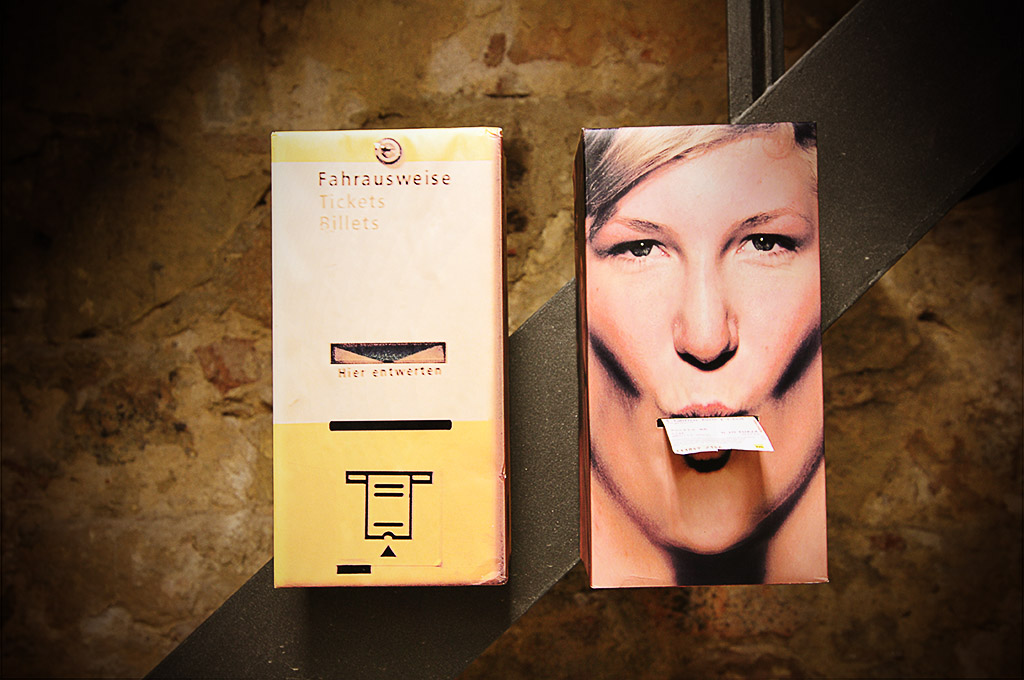
German street art collective Mentalgassi represents fun in the streets. They develop their bright ideas together and inspire each other to share their temporary art with the world.

The artists easily succeed in transforming public space into a witty Alice in Wonderland like surrounding where astonishment is omnipresent and one doesn't cease to smile.

The three former graffiti artist core members expanded their range of media, growing into stylized techniques which are more likely to touch and surprise passers-by.
Highlighting overlooked areas and covering functional objects with large photographic wheat pastes. The majority of the used expressive faces posters aren’t watertight.

Street art installations such as the toilet photo booths, the Public Intimacy pieces or the wheat pasted ticket validators catch the eye, raise eyebrows, make you giggle, look back and giggle some more.

To call attention to the Amnesty International death row case of Troy Davis, the inventive Epicurean minds astounded London by means of their Making the Invisible Visible lenticular fence posters. Their self-evidence breathing work brings on emotions and reflections.

Apogeic urban entertainment putting a smile on your face whilst embellishing the long way to work, what more do you want?

Article written by Ann Timmermans


Invading space


An urban artist who was mad about computers started invading public space in form of mosaic game characters in Paris. He opted for the old, traditional and weather resistant medium because the tiny durable tiles represent the video games' pixels next to the fact that it's simply ideal to use on outside walls.

Space Invader( 1969, FR) catalogues his multicoloured tiling works, provides invasion maps and books.

His gallery work- Invader 's being represented by the Jonathan Levine Gallery- is somewhat different.

He manipulates and arranges Rubik's cubes to form outstanding gallery pieces.
His Rubik's cubism series include interpretations of music album covers, portraits of the Mona Lisa and the Dalai Lama, ... . He uses the mechanical puzzles as a painter uses paint.

His Imatrix pieces show genius thinking from a man who's obsessed by the digital world. When a picture from the digitally encoded piece is being read with a QR code/data matrix application the text "This is an Invasion" appears.

The Frenchman was arrested in LA( April 2011) carrying tiles and a cement bucket.
He has declared he is currently planning a museum invasion.


Article written by Ann Timmermans


Don't do it to impress the press: street artist Roa


Picture: Ann Timmermans, Roa @ Rabot Ghent


Taking it back to the true essence of street art and hip hop culture, Belgian based graffiti artist Roa is so tall that he always stands out in a crowd.


As a youngster he was inspired and influenced by all the aspects of hip hop culture: skating, music of the Wu Tang Clan, Public Enemy, Eric B and Rakim, the Beastie Boys and naturally the freedom of expression by means of graffiti art. At that time his throw ups under bridges and on walls were to be seen in the vibrant streets of his hometown Ghent. 


He evolved from painting in a traditional way to his own graphic style of depicting his subjects, each piece clearly showing his painterly technique and love for nature. He combines rollers and spray cans to form the layers of his master pieces.


Intrigued by biology, his recognizable black and white animals are artistic expressions in correlation with abanonded sites, referring to these industrial spots as oasisses in civilization.


He believes that animals tell so much more about this world then anything or anyone else. No wonder he desired to become a vet as a kid. He easily succeeds in depicting vital beings in a way you may expect from masters as Picasso and Duchamps he loves so much. 


His unique monochrome paintings depicting rhinoceroses, birds, rabbits, fish, monkeys and cockroaches are yet to be admired in all major cities around the world.


Roa does his thing to express himself, to share art instead of the pursuit of his ego. Roa is on the roll!


Article written by Ann Timmermans


Picture Ann Timmermans, Roa @ Interbeton industrial site Ghent
Picture Ann Timmermans, Roa @Interbeton site Ghent